11.29.2011
One Pot Meal: Baked Fish Provençal
Pet peeve: meals that dirty several pots. Or a meal that you start on the stove and transfer to a casserole to put in the oven. Or a meal that dirties the blender or food processor in addition to one or more pots. I hate dishes so I try to keep them to a minimum! Sometimes, when a recipe says to start cooking on the stovetop and transfer to a casserole, I try to figure out if I can do the whole thing in the same pot or skillet. Since my pots are oven safe, that's often a viable option. So that's what I did with this easy fish dish. It's one example of the kinds of simple meals we're eating lately in order to stay sane. Make sure you have a pot with an oven-safe lid, too.
Baked Fish Provençal
(adapted from $3 Dinners)
Ingredients:
1/4 c. olive oil
1 large onion, chopped
3 garlic cloves, minced
1 (14 oz) can diced tomatoes and their juice
3 T. chopped parsley or 1 T. dry parsley
1 T. Herbes de Provence (see note below)
1 bay leaf
2 large potatoes, thinly sliced (or 3 medium or 4-6 small)
1/3 c. chopped and pitted oil cured olives (I find them in the international aisle at Meijer)
unrefined sea salt and freshly ground pepper to taste
1 1/2 lbs fish fillets, such as cod or whitefish, rinsed (make sure it's wild-caught and not from China)
Method:
1. Preheat oven to 375.
2. Heat oil in large skillet on medium. Add onion, cook 3-4 min, adding garlic in the last minute. Add tomatoes, herbes de provence, parsley, bay leaf, potatoes, olives, and salt and pepper to taste. Bring to a boil and simmer, covered, 7-10 minutes until potatoes begin to soften.
3. Remove bay leaf, check seasoning. Remove half of the mixture to a dish (perhaps one you will be eating out of later so as to not dirty an extra dish), and place fish fillets on top of remaining mixture. Place reserved mixture on top of fish.
4. Cover and bake 25 minutes, until fish is opaque and flakes easily with a fork and potatoes are tender.(You can also uncover it for the last 10 minutes or so, see update below.)
I think it's great with a sprinkle of parmesan and a squirt of fresh lemon juice. You can serve it with some vegetables or a salad on the side, but it also makes a pretty complete meal on it's own. Even better!
Note: Don't have Herbes de Provence on hand? Neither did I. There are plenty of recipes online for how to make your own. Here's the one I used. If you're out of something, don't stress about it (unless it's the oregano or thyme). I made mine without savory or lavender. I'm sure it would be extra tasty with those added, but it was plenty good without them, too!
What's your favorite one-pot meal?
[Update: yesterday I heated up the leftovers for lunch in a 250 degree oven for a little over an hour while I was running errands. I turned the heat up to 300 when I got home for 15 minutes or so. These leftovers were even more delicious than the original, which I owe to two things: cooking for so long at a low temperature concentrated the delicious sauce, and heating it uncovered crisped up the potatoes. Our family practically devoured it. I love it when leftovers taste so good!]
This is part of Real Food Wednesday, Gluten-Free Wednesday, This Chick Cooks and Simple Lives Thursday. Check them out for tons of great recipes and kitchen tips!
Labels:
dinner,
potatoes,
recipes,
seafood,
simple meals,
vegetables
11.20.2011
Cook Squash the Safe and Brainless Way
One of the ways we're surviving this stressful time is by doing things as simply as possible. Sometimes those simplifications fall into the 80-20 rule: eat as healthfully as possible 80 percent of the time, and it's okay if the other 20 percent isn't perfect. Like going out for chinese food (boy did that make my husband happy. He's been craving egg rolls for the five years we've been married). Or eating a frozen pizza once in awhile. Or buying store bought bread instead of making it from scratch (though I do usually buy sourdough or sprouted bread...but not always).
Here is one example of a simple method that doesn't compromise health. Cooking and pureeing your own squash or pumpkin is a great way to use local produce and avoid the BPA in canned products, but it's one of those things I'd be tempted to let go in a season such as this one. However, when your CSA keeps giving you squash, you've gotta do something with it! This is the easiest way to use your squash before it rots. And if you don't have the energy to use it right away, it's ok! Freeze it and use it when you feel inspired.
You really can't mess this method up.
Usually, to cook a whole squash, you grab the sharpest knife you own and pray that you won't lose a finger while attempting to cut it in half. Or maybe that's just me. But I've never quite felt at peace about risking my digits like that, and so I've discovered a much easier way to cook a squash. Bonus: you can forget about it and you won't ruin it or burn the house down.
Step One:
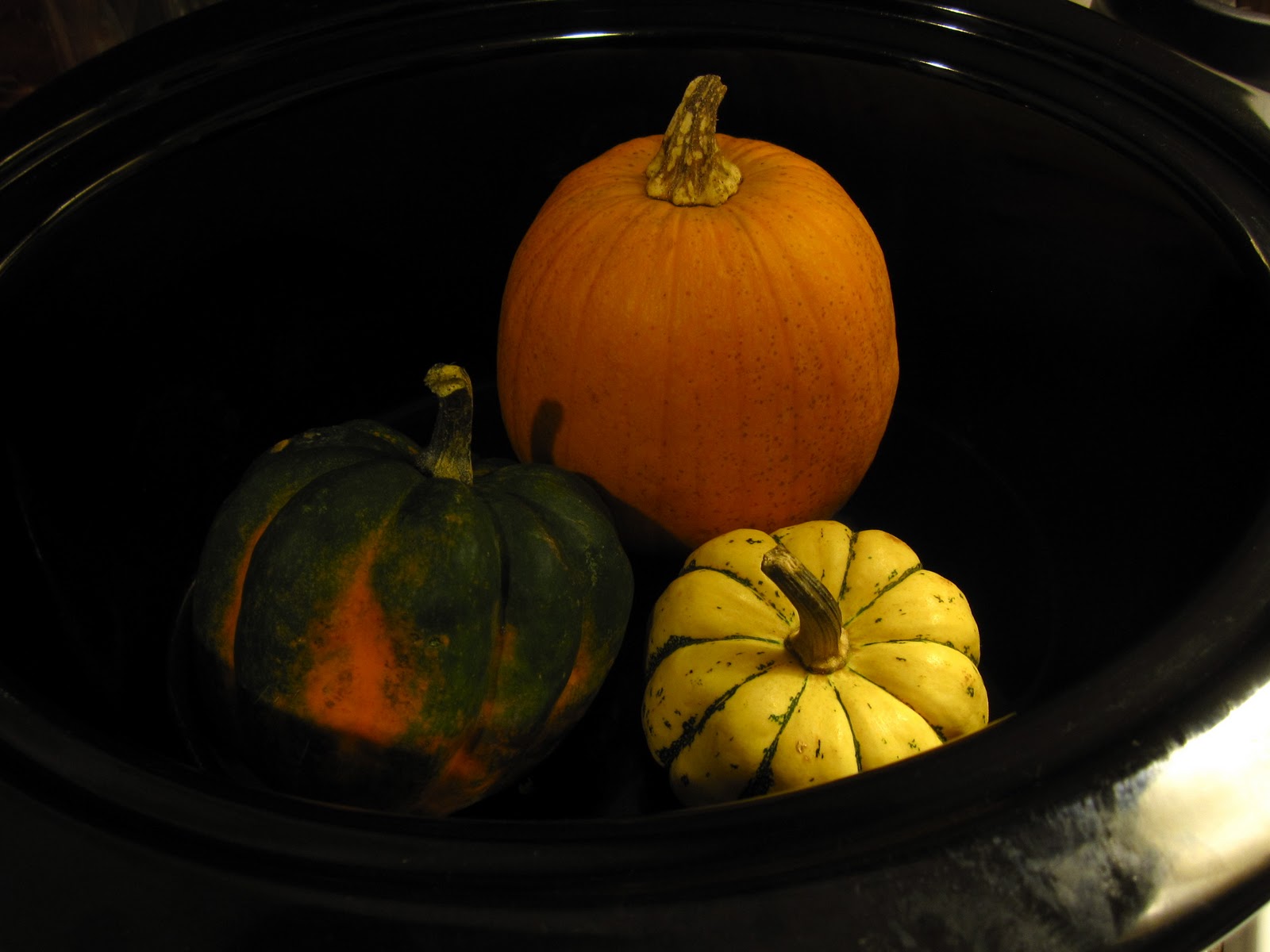
Rinse off your squash and place as many as you want inside your slow cooker. I did three in this picture, in my six quart slow cooker. If you're doing larger ones, maybe just one or two.
Step Five:
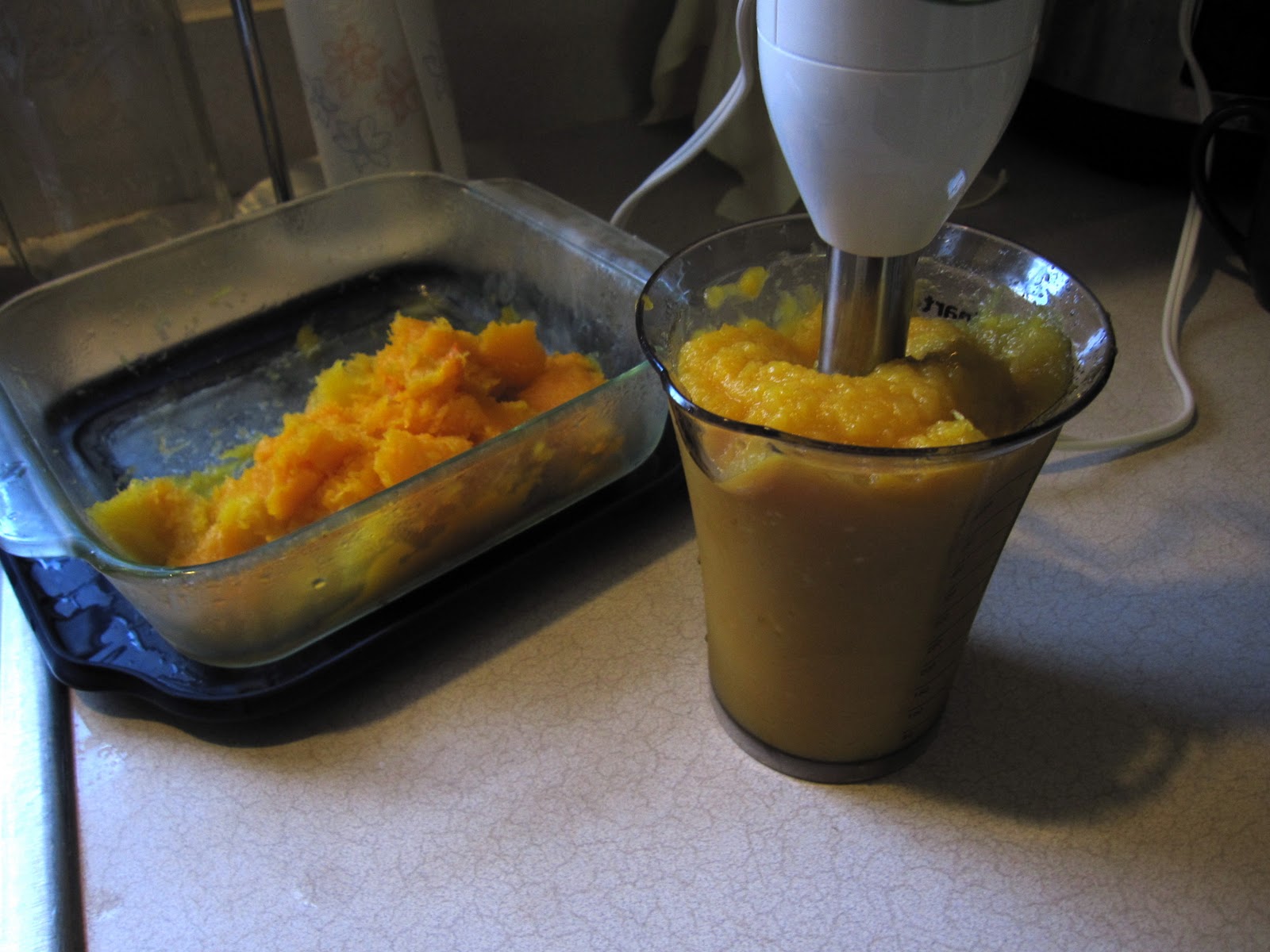
If you want pureed squash, use an immersion blender (my new favorite tool!), a regular blender, or a food processor to puree. (My immersion blender came with this handy little cup - perfect for smoothies! I find it SO much easier to wash the cup and one piece of the immersion blender than to wash all the little pieces of my blender or food processor. Seriously. You need to invest in one.)
Step Six:
Spoon the puree into jars, label, and freeze until needed. A big butternut and a medium acorn yielded about four and a half cups of pureed squash. The stuff in the measuring cup went into our dinner that night. (Pumpkin Sausage Pasta from Simply in Season. Yum.)
Here is one example of a simple method that doesn't compromise health. Cooking and pureeing your own squash or pumpkin is a great way to use local produce and avoid the BPA in canned products, but it's one of those things I'd be tempted to let go in a season such as this one. However, when your CSA keeps giving you squash, you've gotta do something with it! This is the easiest way to use your squash before it rots. And if you don't have the energy to use it right away, it's ok! Freeze it and use it when you feel inspired.
You really can't mess this method up.
Usually, to cook a whole squash, you grab the sharpest knife you own and pray that you won't lose a finger while attempting to cut it in half. Or maybe that's just me. But I've never quite felt at peace about risking my digits like that, and so I've discovered a much easier way to cook a squash. Bonus: you can forget about it and you won't ruin it or burn the house down.
Step One:
Rinse off your squash and place as many as you want inside your slow cooker. I did three in this picture, in my six quart slow cooker. If you're doing larger ones, maybe just one or two.
Step Two:
Put the lid on, and turn the slow cooker on low or high, depending how long you have. I honestly can't tell you how long it's going to take (I told you this was brainless), but they always cook faster than I think they will. Check it after an hour, and then every half hour or so. If you can't check that often, turn it on low. It's done when it pierces easily with a fork.
Step Three:
Remove the cooked squash from the slow cooker and let them cool until you won't burn yourself touching them.
Step Four:
Cut the squash in half using a knife (mmm, now wasn't that easy?). Scoop out the seeds with a spoon and discard. Scoop out the flesh using a spoon. (Notice that's not the same squash you saw in the above picture...something sketchy is going on here...)
Step Five:
If you want pureed squash, use an immersion blender (my new favorite tool!), a regular blender, or a food processor to puree. (My immersion blender came with this handy little cup - perfect for smoothies! I find it SO much easier to wash the cup and one piece of the immersion blender than to wash all the little pieces of my blender or food processor. Seriously. You need to invest in one.)
Step Six:
Spoon the puree into jars, label, and freeze until needed. A big butternut and a medium acorn yielded about four and a half cups of pureed squash. The stuff in the measuring cup went into our dinner that night. (Pumpkin Sausage Pasta from Simply in Season. Yum.)
No more cutting your finger off trying to cut open a squash. Hurray!
Hope you are enjoying this fall season and finding ways to simplify and enjoy each day. :)
This is a part of Real Food Wednesday.
Subscribe to:
Posts (Atom)